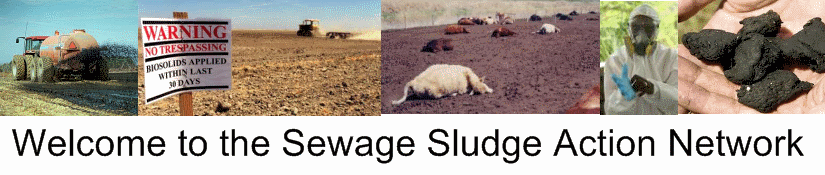
To receive alerts, news and information from the Sewage Sludge Action Network, please join our mailing list.
Mailing ListTo receive alerts, news and information from the Sewage Sludge Action Network, please join our mailing list. Documents
Simpatico LinksUser loginSearch |
Did Sewage Sludge Lace the White House Veggie Garden With Lead?
Starting in the late 1980s and continuing for at least a decade, the South Lawn was fertilized by ComPRO, a compost made from a nearby wastewater plant's solid effluent, a.ka. sewage sludge. Sludge is controversial because it can contain traces of almost anything that gets poured down the drain, from Prozac flushed down toilets to lead hosed off factory floors. Spreading sludge at the White House was a way for the EPA to reassure the public that using it as a fertilizer for crops and yards (instead of dumping it in the ocean, as had been common practice) would be safe. "The Clintons are walking around on poo," the EPA's sludge chief quipped in 1998, "but it's very clean poo." Synagro official pleads guilty to bribing Detroit Council memberMonday, June 15, 2009 "I conspired with others to provide money to elected officials in exchange for favorable votes before the City of Detroit," Rayford W. Jackson, 44, of Detroit told U.S. District Judge Avern Cohn. The council member Jackson admitted to bribing is not identified in court documents, which use the term "Council Member A." However, federal agents have electronic surveillance evidence linking City Councilwoman Monica Conyers to receiving alleged payments in connection with a $1.2 billion Synagro Technologies Inc. sewage contract, persons familiar with the investigation have told The Detroit News. Fish from river tainted with contaminants from sewage sludges spread on farmsFish from river may be tainted Several industries in the Decatur area use the chemical PFOA or perfluoroonctanoic acid in their manufacturing process. When the industries discharge PFOA-tainted waste into the Deactur's sewer system, the sludge is contaminated. I suspected that the waste water from the sewage treatment plant that is discharged into the Tennessee River might also be contaminated. IS SEWAGE SLUDGE REALLY FREE FERTILIZER TO THE FARMER?Press Release We are told that sewage sludge/biosolids are recycled organic human waste, which is true. What is not told is that from 80 to 100,000 chemicals are used in products for personal and home use, in industry, and medical and laboratory facilities. Any drugs or chemicals going down the drain into the sewer system may wind up on the land intact or as chemical mixtures never anticipated or tested for toxicity. The treated sludge also contains bacteria, viruses and intestinal worms and parasites. Class B sewage sludge can have 2 million fecal coliform indicator bacteria (thermotolerant E. coli) per gram (size of a sugar cube) which means there’s pathogenic bacteria in the sludge—but not what type or amount and this will be sprayed or spread on farm fields which will grow human and animal crops and grass for cattle. The waste water treatment plant has to follow EPA and state regulations for processing sewage sludge but this process does not remove the drugs, chemicals, toxic metals, or all of the bacteria, viruses, or parasites. Fecal Coliform Test Puts Public Health at Risk: Sludge -- biosolids -- food -- waterJim Bynum, VP, & Gail M. Bynum, Ph.D Neither the fecal coliform test nor any laws (Solid Waste, Hazardous Waste, Clean Water) protect farmers and the public who are not being told the truth about sludge contaminated with pathogenic microorganisms. Sludge is: 1) a solid waste; 2) a hazardous waste because of E. coli and other pathogens; and 3) a point source pollutant. The current use of the fecal colifom test itself is designed to inhibit the bacterial growth so as to reduce the number of viable but culturable E. coli to less than one percent of the total. It eliminates most indicator E. coli in the sludge sample by making them viable but nonculturable by standard culture methods. This allows unknown amounts of anitbiotic resistant pathogenic superbugs to be spread on farms, parks, school grounds and even home lawns. This practice violates any government regulation for work place safety, especially laboratory safety rules. Superbugs thriving in wastewater treatment plantsby Kate Melville In the first study of its kind, University of Michigan researchers have established that wastewater treatment plants are providing a perfect environment for the emergence of antibiotic-resistant superbugs that eventually end up in neighboring streams and lakes. Simulating pharmaceutical and personal care product transportDate:5/19/2009 MADISON, WI, MAY 18, 2009 Pharmaceuticals and personal care products (PPCPs) carried in biosolids (i.e., treated sewage sludge) may reach surface waters or groundwater when these materials are applied as fertilizer to agricultural land. During the high flow conditions created by land application of liquid municipal biosolids (LMB) the residence time of solutes in soil macropores may be too short for sorption equilibration which increases the risk for leaching. Physically based solute transport simulation models are widely used in environmental risk assessment for pesticides. These models may also be applicable for PPCPs when their physical and chemical properties and soil dissipation characteristics are available. However, these models do not account for non-equilibrium sorption in soil macropores. The model MACRO is one of the models used in environmental risk assessments for pesticides and may have potential as an environmental risk assessment tool for PPCPs.
Crap Happens: A Grist Special Report on How We Dispose of Our Poop
Can the United States continue to flush all that waste down the drain? Can Western-style sanitary practices be replicated throughout the developing world without breaking the natural water and nutrient cycles? And what if the answer is that each one of us needs to start taking more responsibility for where our crap winds up? It ain’t easy being green as it is, but even the most diehard enviros may not be ready to live under the same roof with a composting toilet. Journalist Catherine Price, a contributing editor at Popular Science and a 2008 Middlebury Fellow in Environmental Reporting, gives a crap about crap. Over the course of three days, she’ll take Grist readers on a guided tour through the bowels of sewage. So grab some extra toilet paper and get ready for some straight poop on poop. Day 1 * Sludge, farmer’s friend or toxic slime? Day 2 * Businesses struggle to profit from sewage sludge Day 3 * For some eco-pioneers, solving the sludge problems means getting their hands dirty more about the movie 'Sludge Diet' (showings info. previous posting)From http://www.planetinfocus.org/festival/sludge-diet 'Some call it poison others hail it as environmentally friendly. Who’s telling us the truth about Fertile Residual Material (FRM) aka sludge and who’s lying? The foods that we eat are mostly produced on land fertilized by digester sludge containing dangerous substances. The consequences have been disastrous so far and most feel that governments need to ban its usage instead of regulating it. The continued use of sewage sludge in agriculture and regulating its use to prevent harmful effects on soil, vegetation, animals and man - is an ongoing debate. ' ...and from http://www.thecoast.ca/halifax/bio-not-so-solids/Content?oid=962731 '“It’s a big mistake,” says Maureen Reilly, a veteran biosolid researcher, at a screening of the film Sludge Diet. |
NavigationWhat You Can DoWhat You Can Do [PDF] CalendarNewsSept. 14, 2009 The Cooperative Community Fund Committee of Weaver Street Market awarded the Sewage Sludge Action Network a $500 grant. Please consider making a tax deductible gift to the work of the Sewage Sludge Action Network. Thank you for your support! |
Recent comments
6 weeks 6 days ago
1 year 17 weeks ago